
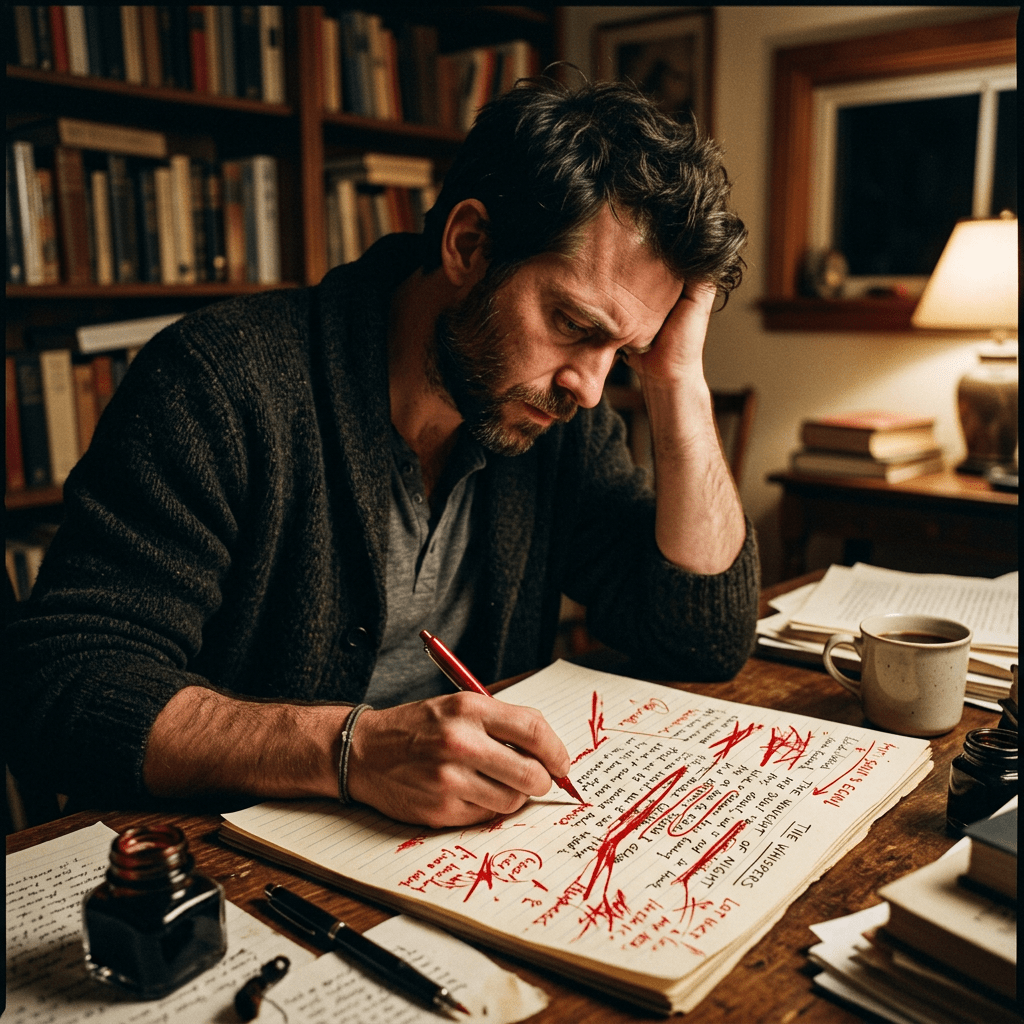
The Ruthless Edit:
Stripping the Scaffolding and Tightening the Wire
Congratulations. You have survived the terrifying blank page. You have poured your raw, chaotic human emotion onto the screen, found your images, and landed your final line. You have a first draft.
Now, it is time to destroy it.
There is a famous literary saying: “Writing is an act of love; editing is an act of murder.” To write contemporary poetry that grips a reader, you cannot be precious about your first drafts. First drafts are for the writer—they are where you figure out what you are trying to say. The edit is for the reader.
When AI writes poetry, it stops at the first draft. It generates a neat, predictable block of text and calls it a day. A human poet, however, knows that the real art happens in the second, third, and fourth passes.
Editing poetry isn’t about fixing typos; it is about increasing voltage. Here is your three-step tactical blueprint for auditing your lines, erasing placeholders, and tightening the tension until the poem vibrates.
1. The Line-Length Audit: Sculpting the Speed
In Page 5, we talked about stanza architecture, but now we need to look microscopically at individual lines. A poem’s line length controls the reader’s internal metronome. If your lines are all the exact same visual length, your reader’s brain will go on autopilot.
To audit your line lengths, pull out a ruler or look at the ragged right margin of your screen. You want to look for two specific flaws: the saggy line and the premature break.
┌───────────────────────────────────────────────────────────┐│ THE LINE-LENGTH AUDIT │├─────────────────────────────┬─────────────────────────────┤│ The Problem Line │ The Tactical Fix ││ • The Saggy Line │ • Chop the filler. Break on ││ (Drifts across the page, │ a high-stakes noun or ││ losing sonic tension) │ verb to drop the weight. ││ │ ││ • The Premature Break │ • Pull the words back up. ││ (Chop-chop-chop style │ Let a line have breath ││ that breaks on weak │ before forcing the jump. ││ words like "the" or "and")│ │└─────────────────────────────┴─────────────────────────────┘
The Enjambment Test
Enjambment is when a sentence spills over a line break without punctuation. When you break a line, the last word of the line carries 40% of the stanza’s total weight.
Go down your poem and circle the very last word of every single line. If your circled words are the, of, and, then, but, completely, your line breaks are broken. You are breaking on breath, not on impact.
- The Rule of Thumb: Try to end your lines on a hard noun, a vivid verb, or an electric adjective. Give the reader’s eye something solid to stand on before it leaps across the white space.
2. Erasing placeholders: The Cliché Exorcism
When you are writing a first draft at 2:00 AM, your brain is tired. To keep up with your racing thoughts, your subconscious will automatically grab placeholder language—pre-fabricated phrases, poetic clichés, and emotional shorthand that you’ve read a thousand times before.
An edit is where you systematically hunting these placeholders down and replace them with specific, idiosyncratic human truths.
The Search-and-Destroy List
- Filter Words: Erase words like I saw, I felt, I noticed, I thought, I watched.
- First Draft: “I watched the snow fall on the pavement.”
- The Ruthless Edit: “Snow buried the grease on the pavement.” (By removing the “I watched,” you drop the reader directly into the cold air without a middleman).
- The “Very” and “Really” Parasites: These words are weak amplifiers. If something is very cold, it is wintry or arctic. If something is really loud, it is a din or a clatter.
- Poetic Overwriting: Look for words that only exist in bad poetry: azure, gossamer, slumber, twilight, o’er. If you wouldn’t say the word out loud while buying groceries, be incredibly careful about putting it in a modern poem. It smells like an artificial imitation of art.
3. Tightening the Tension: The 20% Reduction
Poetry is compressed speech. If a short story is a swimming pool, a poem should be a pressure washer.
The fastest way to instantly make your poem look and feel like it was written by a seasoned professional is to force a strict 20% word-count reduction. Go through your draft with a black marker and strike out every word that is not pulling its own weight.
Where to Cut the Fat
Look closely at your prepositions (of, to, for, on) and articles (the, a, an). English poetry can handle a surprising amount of omission while remaining perfectly understandable.
Let’s watch a line go through the compression machine:
First Draft (Loose, narrative, conversational): “There was an old blue Chevy parked out under the oak tree in the driveway, and it was leaking a slow puddle of dark oil onto the gravel like it was bleeding.” (31 words)
The 20% Reduction (Tighter, sharper): “An old blue Chevy rots under the oak. / Dark oil pools in the driveway gravel— / a slow, metallic bleed.” (18 words)
Look at what happened mechanically. We chopped “There was an,” “parked out,” “and it was leaking a,” and “onto the like it was.” We upgraded the passive verb “parked” to the visceral verb “rots.” We compressed the weak cliché “like it was bleeding” into the stark, concrete noun phrase “a metallic bleed.”
The second version has twice the emotional gravity because the words aren’t drowning in linguistic packing peanuts.
The Checklist: The Sunday Morning Audit
When you think a poem is completely finished, leave it alone for 48 hours. Let the emotional heat cool down. On Sunday morning, open the file and do one final, cold-blooded pass:
- Read it backward: Read your poem from the final line up to the first line. This breaks the narrative spell and forces your brain to look at each line strictly as an independent unit of sound and texture. If a line feels clunky when read completely out of context, it needs mechanical help.
- The Whisper Test: Read the poem out loud into an empty room. Mark every spot where your tongue trips, where you run out of breath, or where you naturally stumble over a consonant cluster. If your mouth struggles to say it, the rhythm is fighting your anatomy. Fix the syllables.
- The “So What?” Razor: Look at every single stanza and ask: If I cut this entire room out of the house, does the building fall down? If the answer is no—if the stanza is just a pretty description that doesn’t advance the emotional argument—throw it in the trash.
Editing isn’t a chore; it is where you find the true diamond hiding inside the rough stone of your thoughts. Be ruthless, be patient, and trust that the cuts you make are exactly what will allow the poem to finally breathe.

