
Stanza Architecture:
Building Houses out of White Space
When a reader lands on a page of prose, their brain prepares for a marathon. They see dense, edge-to-edge blocks of text, and they know their job is to move steadily forward from left to right.
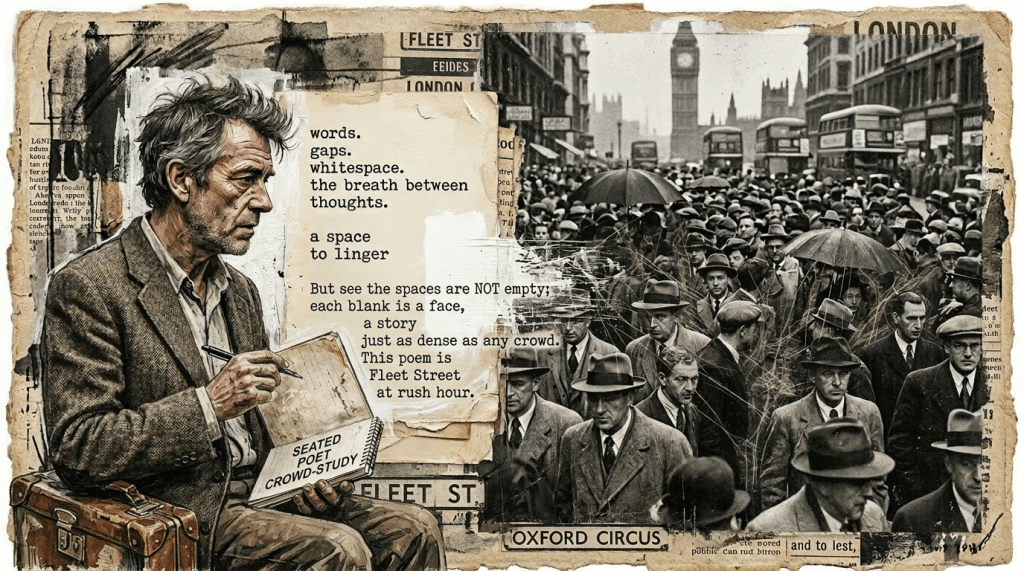
But when a reader looks at a poem, before they read a single syllable, their eye encounters something entirely different: the white space.
In poetry, white space is not empty nothingness; it is a physical force. It is silence, it is gravity, and it is time. The way you slice your poem into stanzas (the Italian word for “rooms”) determines exactly how fast your reader breathes, where their mind hesitates, and how heavily an image hangs in the air.
If line breaks are the musical notes, stanza breaks are the structural architecture. Let’s explore how to build these rooms and how to use the empty page as a quiet, powerful form of punctuation.
1. The Core Rooms: Couplets, Tercets, and Quatrains
Just as different rooms in a house dictate different behaviors (you don’t sleep in the kitchen), different stanza lengths dictate different psychological and musical movements.
The Couplet (2-Line Stanzas)
- The Vibe: Symmetry, balance, confrontation, or deep intimacy.
- The Mechanics: Because couplets are pairs, they naturally create a mirroring effect. They feel like two people arguing, a reflection in a mirror, or a heavy footstep (left, right, left, right).
- How to use it: Couplets are brilliant for building quiet, clinical tension or stark clarity. Because the white space arrives every two lines, the reader is forced to pause constantly, making every single line feel heavy and deliberate.“I watched the ambulance turn down our street / and didn’t tell you that I kept the keys.”
The Tercet (3-Line Stanzas)
- The Vibe: Instability, momentum, or a spinning wheel.
- The Mechanics: Human brains love even numbers because they feel stable. A 3-line stanza is inherently unstable. The third line constantly acts as a tipping point, spilling the reader’s eye over the edge of the white space into the next stanza to find balance.
- How to use it: Use tercets when your poem needs forward momentum, or when you are dealing with themes of triplets—past, present, future; mother, father, child. The unevenness keeps the reader slightly off-kilter.
The Quatrain (4-Line Stanzas)
- The Vibe: The brick wall. Solid, narrative, and foundational.
- The Mechanics: The quatrain is the most common stanza form in human history. It feels safe, traditional, and sturdy—like the four corners of a house. It gives the reader enough room to settle into a narrative or an image before the curtain drops.
- How to use it: If you are telling a complex story, tracking a memory over time, or writing a ballad, the quatrain provides the perfect structural backbone. It anchors the poem so the imagery can fly wild without losing the reader in chaos.
2. White Space as Ghost Punctuation
Most beginners think they have to rely entirely on commas, periods, and em-dashes to control the timing of a poem. But a master poet uses the white space of the page to create pauses that standard punctuation could never achieve.
Think of white space as the volume dial of silence.
The Caesura (The Mid-Line Gulf)
A caesura is a structural pause or fracture within a single line. Traditionally done with punctuation, modern poets often drop a massive physical block of white space directly into the center of a sentence to create an intake of breath or a sudden drop in altitude.
“I am trying to tell you the house was already empty.”
By forcing the eye to leap across that blank gap, you simulate the physical sensation of hesitation, a stutter, or a secret that is difficult to speak aloud.
The Dropped Line (The Staircase)
Instead of starting the next line at the left margin, indent it so it aligns perfectly with where the previous line ended.
“We stood by the radiator
watching the snow fall
into the dark.”
This staircase effect allows the rhythm to remain continuous and unbroken, yet it visually mimics a falling sensation—a slow, downward slide into a memory or an emotion.
3. The Blueprint: Tracking Reader Speed
| Architecture Choice | Visual Shape on Page | Effect on Reader’s Speed | Best Used For… |
| Dense Blocks (No breaks) | Long, heavy column | Fast, breathless, overwhelming | Panic, streams of consciousness, rants |
| Micro-Stanzas (Single lines) | Floating, isolated lines | Extremely slow, highly fragmented | Grief, heavy realizations, stark imagery |
| Indented Enjambment | Sprawling across the page | Erratic, searching, sweeping | Following a train of thought, wind, or flight |
The Editing Room: A Blueprint for Your Next Draft
When you have a draft that feels a little flat, print it out. Take a pair of scissors and literally cut the poem apart between every single sentence.
Spread the slips of paper out on a table. Now, experiment with the architecture:
- Group them into strict couplets. Notice how the poem instantly slows down and feels more intimate, like a confession.
- Pull one crucial line out and let it sit entirely by itself in a vast sea of white paper. Watch how that single line suddenly catches fire, pulling ten times more emotional weight because it has no neighbors to lean on.
- Erase your periods and commas and let the line breaks and stanza breaks do 100% of the punctuation work.
Remember, ink is what you use to give the reader information, but the white space is what you use to give them room to feel it. Don’t be afraid to leave the page empty. Silence is often the loudest part of the song.

